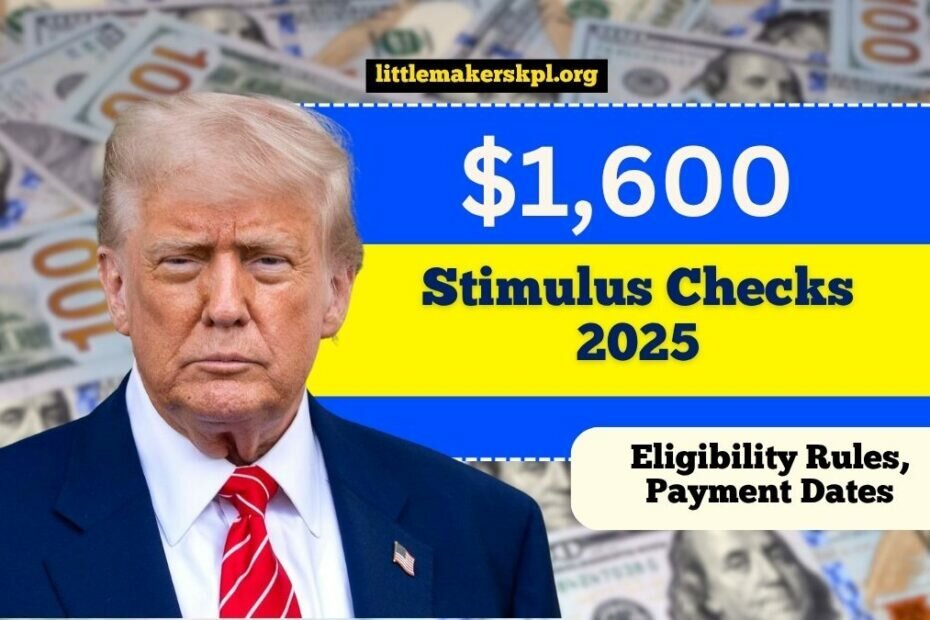

As inflation remains high and household budgets are stretched, talk of a new $1,600 stimulus check in 2025 has gained traction. Reports suggest the U.S. government, via the IRS, may issue these payments to low- and moderate-income Americans to ease economic pressure and boost consumer spending. Below you’ll find the latest details, eligibility rules, payment schedules, and caveats.
Rising costs for essentials—food, rent, utilities, healthcare—have eroded many families’ purchasing power. Proponents argue that a direct cash injection can help:
- Alleviate short-term financial stress
- Encourage consumer spending and economic growth
- Provide relief to households that haven’t recovered fully from past shocks
Analysts view it as a hybrid relief-plus-stimulus measure designed for today’s cost pressures (rather than pandemic relief).
| Feature | Proposed Details |
|---|---|
| Payment Amount | $1,600 per eligible individual |
| Distribution Mode | Direct deposit, paper checks, possibly prepaid debit cards |
| Income Thresholds | Up to $75,000 (individual), $150,000 (married filing jointly) |
| Head of Household Limit | Up to $112,500 |
| Phase-out Above Limit | Reduced payments for those above thresholds, based on AGI |
| Dependent & Supplemental Eligibility | Some older adults, disabled adult dependents may receive partial amounts |
| Start of Payments | Aim to begin in April 2025, rolled out in phases |
| Automatic Payments | Likely automatic for those with prior IRS tax filings and banking info |
To receive a $1,600 stimulus check, proposals suggest you’d need to meet conditions such as:
- Income within limits: $75,000 or less for individuals, $150,000 or less for married joint filers.
- Filing a valid tax return: The IRS would use your most recent tax filing (or require one).
- Valid U.S. citizenship or residency status: With correct Social Security Number or equivalent.
- No disqualifying consent or exclusion rules (dependent status, etc.).
Those above the income thresholds may still get reduced amounts depending on adjusted gross income (AGI) projections.
- Direct deposit is expected to be the primary method for those whose banking details are on file with the IRS.
- Paper checks or prepaid debit cards could serve those without or who don’t update banking info.
- Payments may be phased, not all distributed at once, to manage IRS processing and prevent system overload.
- The start window is slated for April 2025, with most eligible recipients seeing disbursement in the early months.
- Because stimulus checks require legislation or IRS authorization, no guarantee exists until an official program is enacted.
- As of mid-2025, no new federal stimulus is confirmed. What you may hear are proposals or political plans.
- Earlier in 2025, the IRS continued distributing unclaimed $1,400 stimulus payments tied to Recovery Rebate Credit filings for 2021. These are not new stimulus checks.
- Any new payments must pass through Congress or IRS rulemaking before actual disbursal.
- Not all who expect may qualify; phase-outs and exclusions will limit reach.
- Scammers may exploit rumors; only trust official IRS or Treasury sources.
- Ensure your latest tax return is filed, with banking information updated.
- Monitor announcements from the IRS or Congress about stimulus programs.
- Use the IRS “Get My Payment” tool (if activated) to check status.
- Beware of phishing attempts or sites promising early access to stimulus funds.
The idea of a $1,600 stimulus check in 2025 aims to address rising living costs and help households regain financial footing. While proponents emphasize relief and economic stimulus, the initiative remains subject to legislation and IRS implementation.
To maximize your chance: ensure your tax filings and bank data are current, and keep an eye on official IRS or congressional updates. If approved, this could be one of the more significant relief efforts beyond usual tax adjustments in 2025.
No — it is a proposed relief measure and not yet law. Payments will only move forward if approved by relevant authorities.
No. It’s likely limited to those within income and filing thresholds. Some above limits may receive partial amounts; many will be excluded entirely.
If the program is adopted, the proposed start is April 2025, with phased distribution over subsequent months.