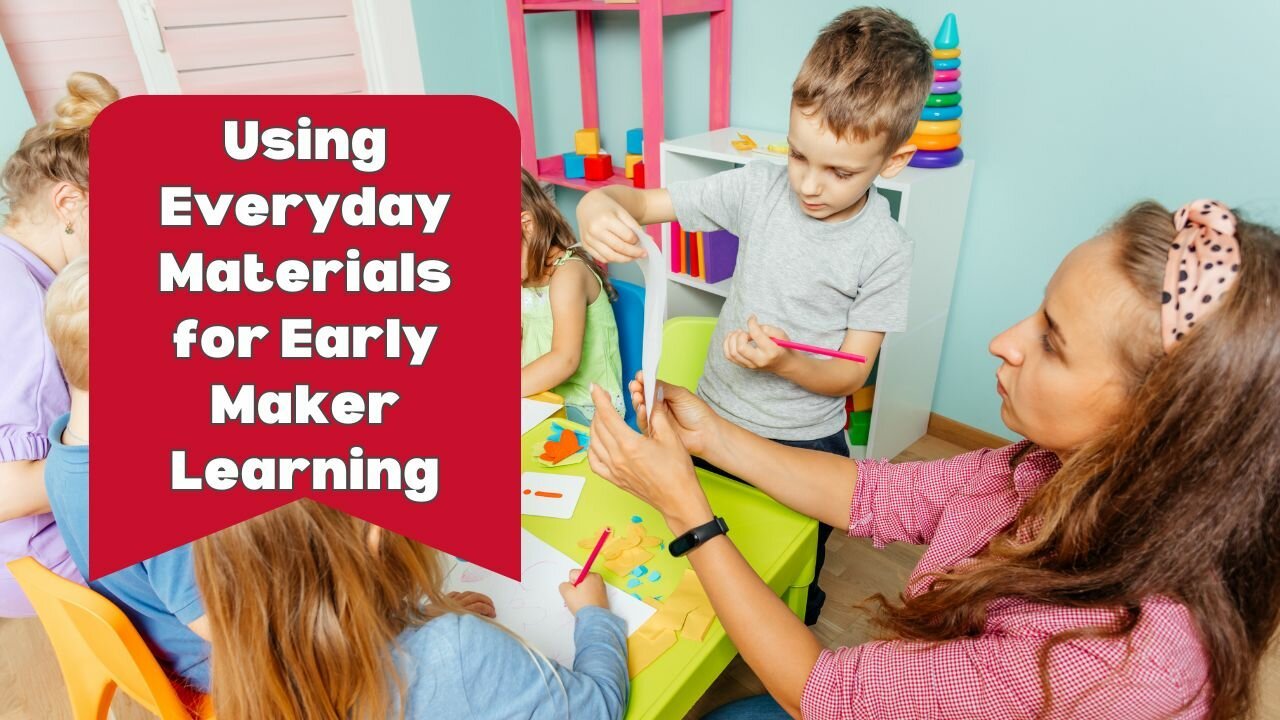
In recent years, the maker movement has gained traction in education, emphasizing hands-on, inquiry-driven learning. For very young children—preschoolers and early primary grades—maker learning doesn’t need expensive kits or specialized tools.
Rather, everyday materials (often called “loose parts”) can fuel creativity, experimentation, and early STEM thinking. Using such materials fosters problem solving, fine motor skills, spatial reasoning, and creative confidence.
This article explores how to use everyday materials in early maker learning: the rationales, practical strategies, evidence and data, sample activities, challenges and mitigations, and recommendations. A table summarizing key materials and learning goals is included.
The term everyday materials here refers to both natural and manmade loose parts that can be manipulated, repurposed, or recombined (e.g., paper, cardboard, straws, bottle caps, fabric scraps, sticks, buttons, recycled containers).
When children work with open-ended materials rather than fixed kits, they engage in divergent thinking. Educators call these loose parts “powerful provocations” because they invite multiple possibilities rather than a single “right” outcome.
As Diann Gano describes it, children move from simple two-dimensional play to more complex three-dimensional structures over time.
High-end maker kits (robotics, 3D printers) can be costly, limiting access in under-resourced settings. In contrast, everyday materials are low-cost or free, making maker learning more inclusive.
A recent study on democratizing making showed how e-waste and discarded objects can engage under-resourced communities in design and innovation.
Evidence suggests that high variability in learning materials (i.e., exposing children to many different kinds of materials) benefits their ability to recognize and generalize patterns better than repeated exposure to the same materials.
In early childhood education, frameworks like PRISM (Preschool Rating Instrument for Science and Mathematics) emphasize the presence of materials for counting, classifying, measuring, geometry, and explorations. Everyday materials can fulfill many of these roles.
Moreover, maker education is a natural extension of Reggio Emilia–inspired approaches, which view the environment as the “third teacher” and favor open-ended, natural, and recycled materials.
See also What We’ve Learned From a Decade of Library Maker Programs
- Loose Parts and Open-Endedness
Provide a rich variety of loose parts (natural and synthetic) rather than fixed toy sets. Encourage children to assemble, disassemble, combine, repurpose. - Scaffolded Exploration
Educators should provide provocations or prompts (e.g. “What can you build that will roll?”) rather than detailed instructions. Over time, fade scaffolding to let children lead. - Iterative Design and Reflection
Teach children to plan, test, fail, revise. Maker learning thrives when learners treat mistakes as opportunities to redesign. - Integration Across Domains
Encourage blending math, science, literacy, art. For example, children might record observations (literacy), predict whether an object will sink (science), count components (math), and design aesthetics (art). - Teacher as Co-learner and Observer
The role of the educator is to observe, document, ask open questions, and sometimes join as a co-maker rather than a director. - Cultural Responsiveness
Incorporate materials and ideas from children’s home cultures. This ensures children see their identities and backgrounds reflected in the maker space.
| Material Type / Example | Possible Use in Maker Activity | Learning Objectives / Skills Developed |
|---|---|---|
| Cardboard boxes, tubes, cartons | Construct towers, tunnels, models | Spatial reasoning, measurement, engineering thinking |
| Bottle caps, lids, buttons | Wheels, connectors, mosaics | Patterning, counting, fine motor skills |
| Straws, pipe cleaners, sticks | Frameworks, structures, bridges | Geometry, structural stability, design thinking |
| Fabric scraps, yarn, ribbon | Sewing, weaving, mixed media art | Texture, fine motor coordination, aesthetics |
| Rocks, shells, sticks | Natural sculpture, collage, sorting | Observation, classification, nature connection |
| Aluminum foil, plastic wrap, cling film | Create molds, reflectors, coverings | Properties (flexibility, reflectivity), experimentation |
| Recycled containers & lids | Storage, component housing, sound makers | Engineering design, volume, repurposing mindset |
| Paper, tape, glue | Sketching, prototyping, connecting | Planning, iteration, model building |
Materials: Straws, tape, paper clips, small cardboard pieces
Procedure: Challenge children to create a bridge that can support a small toy car. Let them test, observe sagging, revise supports. Discuss: Which designs worked best? Why?
Learning Outcomes: Stability, load distribution, trial and error, measurement.
See also Tips for Running Virtual Maker Programs for Young Children
Materials: Recycled containers, aluminum foil, clay, straws, rubber bands
Procedure: Children design vessels and test whether they float in water. Can they improve their design?
Learning Outcomes: Density, buoyancy, prediction and revision, properties of materials.
Materials: Buttons, small toys, fabric, cardboard, sticks
Procedure: Children choose a story (or make up one) and build a scene or diorama using loose parts. They then narrate or present their structure.
Learning Outcomes: Narrative skills, design, symbolic thinking, language development.
Materials: Cardboard, straws, paper, pins
Procedure: Children design a propeller that will spin under a fan or by blowing. They can test various shapes and angles.
Learning Outcomes: Cause and effect, angles and rotational motion, iteration.
Materials: Paper, cardboard, mirrors, pencils, rulers (or use simple toolkit)
Procedure: Invite children to create bar, line, or pie charts physically using materials (e.g. stacking blocks or coloured strips). A recent study used everyday materials to foster children’s data visualization literacy.
Learning Outcomes: Data sense, representation, comparison, proportionality.
- Pattern Learning & Variability: Children exposed to a greater variety of materials perform better in generalizing patterns, compared to repeated use of the same materials.
- Maker Education Outcomes: Studies highlight that maker approaches boost student engagement, collaboration, self-efficacy and creativity.
- Loose-Parts Play: Play with loose parts gradually increases in complexity (from flat arrangements to volumetric structures), supporting spatial and executive skills.
- Computational Thinking Even for Young Learners: Reviews suggest that early educational experiences with technology or logic (e.g. blocks, unplugged tasks) cultivate computational thinking concepts.
- Professional Observation Tools: Instruments like PRISM assess how well classroom materials support science and math learning; using everyday materials addresses key criteria.
Although many studies focus on older children, the principles are applicable to early years when suitably scaffolded.
You don’t need a whole lab—designate a table or bin with loose parts. Begin with basic materials and expand over time.
To maintain novelty, rotate sets of materials (e.g. one week only fabric, next week only recycled containers). This aligns with findings about the benefit of high variability.
See also Stories That Build – Craft Meets Reading In Early Childhood
Use photos, children’s words, sketches to document progress. Displaying creations honors children’s work and can spark inspiration among peers.
Examples: “What happens if you change this part?” “Why did your design falter here?” “How might you improve it?”
Offer minimal frameworks or constraints (e.g. materials must be joined, must support weight), then let children lead. Gradually fade scaffolds.
Embed maker tasks with science, math, literacy goals. E.g. counting the number of pieces used, writing a design explanation, discussing material properties (waterproof, bendy, rigid).
Celebrate redesign and “failure moments” as part of the process rather than mistakes to avoid.
Allow educators time to tinker with loose parts themselves. This builds empathy and deeper understanding of possibilities and constraints.
Involve materials children encounter at home or from local crafts (e.g. seed pods, cloth scraps, local packaging) to make connections to their lived experience.
| Challenge | Mitigation Strategy |
|---|---|
| Mess and clutter | Use bins, trays, sorted containers; establish cleanup routines and roles. |
| Overwhelm from too many choices | Start with a limited set, then gradually expand. |
| Gap between learners (some advance faster) | Use tiered challenges or extension tasks for advanced makers. |
| Teacher hesitation or lack of confidence | Provide professional development, model tinkering sessions, peer collaboration. |
| Storage and wear & tear | Label and organize, periodically discard broken parts, repurpose remnants. |
| Curriculum alignment pressure | Tie maker projects to curriculum standards (math, science, language) explicitly. |
Using everyday materials for early maker learning offers a powerful, equitable pathway to nurture creativity, problem solving, and foundational STEM thinking in young children.
With loose parts, children begin with simple explorations and gradually progress into more complex designs. Research supports the value of material variability, scaffolded iteration, and maker mindsets for boosting engagement and deeper learning outcomes.
Educators can start small—designate a corner, rotate materials, scaffold minimally, document the process, and gradually build capacity. Challenges such as clutter or curricular pressure can be mitigated with planning, structure, and linking to learning objectives.
Ultimately, when children transform what adults may see as “trash” into tools of invention and play, we help them internalize a maker identity: that they are designers, problem solvers, and capable creators. Everyday materials are not just accessible—they are transformative.
Children as young as 3 years old can engage meaningfully with loose parts—sorting, assembling, exploring shapes. With scaffolding, even toddlers can benefit. The complexity evolves with age.
No. Kits and structured materials have value too. The aim is to balance open, everyday materials with occasional guided kits. The everyday materials foster creativity, whereas kits can introduce particular tools or concepts.
A minimum of 30–60 minutes twice weekly can yield meaningful experiences. Over time, this can increase. The key is sustained engagement rather than one-off sessions.