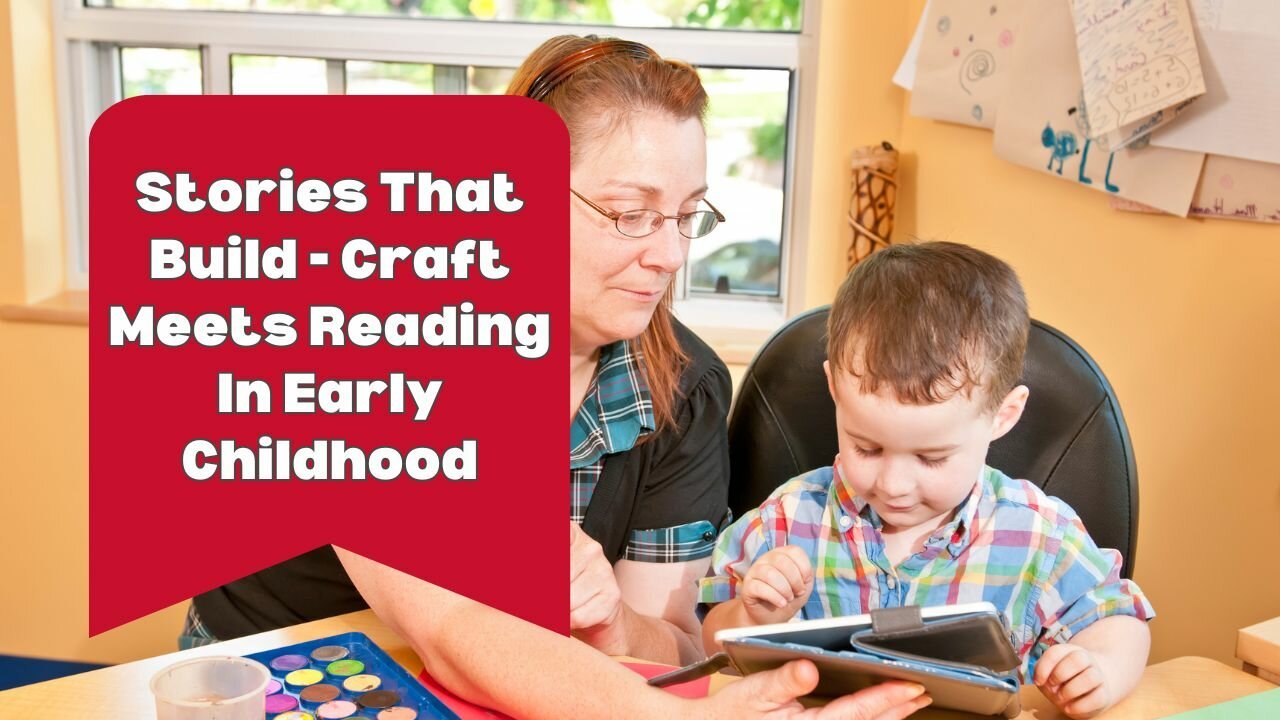
Families are flocking back to public libraries and early-learning programs, and the trend is still rising in 2025. Branches report millions of programs and tens of millions of participants nationally—proof that caregivers value hands-on, low-cost learning close to home.
That surge makes now the perfect time to blend shared reading with simple craft so children don’t just hear stories—they build them.
When craft follows a read-aloud, children immediately reuse new vocabulary, act on story structure (beginning-middle-end), and practice fine-motor and self-regulation skills.
The winning recipe this year is lo-fi before hi-tech: open-ended materials (cardboard, tape, paper, fabric scraps, safe connectors) plus tiny doses of coaching for caregivers. No makerspace required—just a bin, a plan, and a picture book.
- Language growth: Read-alouds expose children to rich, rare words and complex sentences. Craft time invites them to use those words (“sturdy,” “pointed,” “glide,” “shadow”) while explaining choices.
- Comprehension & narrative: Turning a plot problem into a build (“keep the wolf’s wind out,” “help the character cross water”) requires retelling and cause-and-effect reasoning.
- Fine-motor & writing readiness: Tearing tape, pinching clips, threading yarn, and drawing labels strengthen hand muscles and bilateral coordination that support handwriting later.
- Executive function & SEL: Short plan → test → tweak cycles build focus, persistence, turn-taking, and flexible thinking—the heart of school readiness.
- Caregiver confidence: Quick coach-the-grownup lines (“say this, try this, praise this”) turn families into daily literacy partners at home.
A 45-minute “Read + Make” block works in libraries, classrooms, and living rooms:
- Warm-up (5 min): Hello rhyme, show the craft bin, preview the challenge in kid-friendly language.
- Read-aloud (10–12 min): Pause to wonder, predict, and highlight one target word you want echoed later (e.g., stability, float, shadow).
- Mini-lesson (2–3 min): One idea only (“Triangles make structures sturdier” or “Bigger canopies fall slower”).
- Craft stations (18–20 min): Roles posted—Builder / Helper / Tester—with picture instructions.
- Share-out (3–5 min): Two teams show builds; everyone reuses the target word.
- Take-home (1 min): Give a prompt card and invite a photo next visit.
See also How Grandparents and Caregivers Can Support Early Making
| Story Theme | Craft Challenge | Skills Strengthened | Low-Cost Materials | Caregiver Coaching Lines |
|---|---|---|---|---|
| Weather / “Big Bad Wolf” | Build a wind-proof house and test with a “wind” device | Vocabulary, stability, iteration | Cardboard squares, tape, craft sticks, clothespins; small fan/hair dryer | “Where could triangles make it sturdier?” |
| Journeys & Bridges | Make a river bridge that holds 3 books | Measurement, spatial reasoning | Blocks, cardboard beams, cups as piers, tape | “What’s the weak point? How can we fix it?” |
| Flight & Feathers | Design a parachute for a toy; compare canopies | Prediction, data collection, fine-motor | Plastic bag, string, paper clips, tape, toy, stopwatch | “What changes if the canopy is bigger?” |
| Night / Shadows | Put on a shadow theater retell in 3 scenes | Narrative, confidence, visual reasoning | Lamp/flashlight, sheet screen, cutouts | “Tell the story with a beginning-middle-end.” |
| Boats & Water | Build a boat and count penny cargo | Buoyancy, estimation, record-keeping | Foil, straws, tape, pennies, tub of water | “Which shape holds more weight?” |
| Homes & Habitats | Craft an animal shelter with needs in mind | Empathy, planning, vocabulary | Cardboard, fabric scraps, clips, markers | “What does your animal need to feel safe?” |
| Helpers & Robots | Make a draw-bot that wiggles lines | Cause-and-effect, design | Cup, markers, tape; optional small motor + battery | “What makes the lines change direction?” |
| Community & Maps | Create a story map of key places | Sequencing, spatial language | Paper roll, stickers, crayons, yarn “roads” | “Can you label the start, middle, and end?” |
Tip: Keep each station to six children for calm, high-quality participation.
See also How Making Encourages Collaboration And Teamwork In Young Kids
- Storage & Mobility: two rolling carts; a dozen clear bins; laminated photo labels (≈ $250)
- Loose Parts: cardboard squares, jumbo craft sticks, clothespins, rubber bands, paper tubes, clean caps, string (≈ $120)
- Connectors: painter’s tape (bulk), hook-and-loop dots, brads, binder clips (≈ $110)
- Engineering Sets: straw-connector kit; bulk magnetic tiles (≈ $350)
- Light & Shadow: desk lamp, flashlights, translucent blocks (≈ $120)
- Art & Labeling: washable markers/crayons, stampers, giant paper rolls (≈ $100)
- Safety & Care: wipes, table covers, small-parts bin for 3+ area (≈ $50)
Stretch items (+$400–$800): button maker, laminator, beginner circuits (snap-style), recordable “story buttons,” one Chromebook + document camera for demos.
- Dual-language labels and picture-first signage reduce reading barriers.
- Multiple entry points: draw first, build first, or narrate first; honor all approaches.
- Sensory supports: noise-dampening earmuffs, a quiet corner, and fidget tools keep emotions in the green zone.
- Access for all: offer floor and table stations; add step stools and wide paths for strollers and wheelchairs.
- Age zoning: bins labeled “Small parts for 3+”; tool talks (how to carry scissors, where tape lives) keep sessions safe without dampening curiosity.
- Cap each station at six children; run 25-minute rotations on the hour.
- Assign rotating roles (Builder / Helper / Tester); use a visible timer.
- Post a picture first-then-next schedule to smooth transitions.
- End with a compliment circle focused on process (“You tried three ideas!”), not perfection.
Caregivers are the best learning accelerators. Post three script lines at every table:
- Name the feeling + strategy: “You looked frustrated and took a deep breath—that helped.”
- Invite turn-taking: “When you’re done, say ‘Your turn now’.”
- Praise the process: “You tested, changed, and explained—that’s how scientists think.”
See also The Role of Making In Early Childhood Cognitive Growth
These micro-moves multiply vocabulary, self-regulation, and confidence without adding minutes to your agenda.
Hands-on learning shouldn’t stop at the exit. Modern programs pair in-branch sessions with:
- Hotspot lending (typically 4–6-week loans with auto-renewals) for families with limited home broadband.
- Maker backpacks (loose parts + prompt cards + safety tips) for checkout.
- QR mini-lessons (30–60 seconds; data-light) that show the one technique kids learned today—perfect for phones.
Result: families keep building at home, return with photos and one-sentence captions, and stick with programs longer.
Pick five measures to capture every session and report quarterly:
- Attendance (children + caregivers).
- Time-on-task (average minutes engaged at stations).
- Vocabulary & math talk (tally target words overheard).
- Retries after failure (count “try-again” moments).
- Caregiver confidence (one-question exit poll: “We can do this at home”).
Attach two photos (with permissions) and one family quote. This tight, visual evidence convinces stakeholders better than long narratives.
Week 1 — Routines & Roles
- Book: wind or wolf theme → wind-proof house.
- Teach roles, feelings board, and the compliment circle.
Week 2 — Measure & Compare
- Book: bridges or travel → river bridge.
- Graph “holds 1/2/3 books”; send home a bridge prompt card.
Week 3 — Share & Teach
- Book: night or shadows → shadow theater.
- Caregivers practice sentence frames (“What changed? What next?”).
Week 4 — Invent & Reflect
- Book: birds or flight → parachute zone.
- Photo “how-to” cards; plan a family craft night.
Pairing stories with simple craft turns listening into doing—and doing into thinking. Children leave with new words, tested ideas, stronger fine-motor control, and the confidence to try again.
Caregivers leave knowing exactly what to say and do at home. You don’t need a lab—just loose parts, clear routines, brief metrics, and a great picture book.
Start with one cart, two stations, and a 45-minute plan. In a few weeks you’ll see longer focus, richer talk, kinder teamwork—and families who can’t wait to come back.
No. Lo-fi materials spark more language, turn-taking, and persistence than gadgets. Add simple tech only if it clearly improves reflection (e.g., a document camera for “how-to” cards) or access (tele-crafts).
Use age-zoned bins (“Small parts for 3+”), role cards, and two station choices. Keep sessions 25 minutes with a visible timer and a first-then-next chart.
Praise the process, not the product: “You tried three designs and asked a helper—that’s teamwork.” Process praise builds grit and language faster than end-product praise.