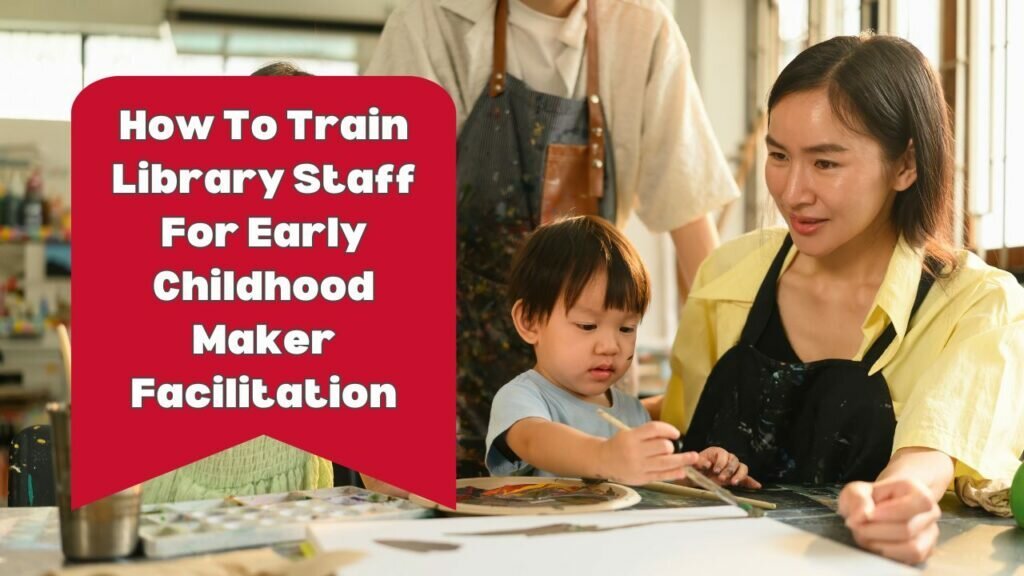
The rise of maker-centered learning has transformed the role of libraries from quiet repositories of books into dynamic learning hubs.
More and more, libraries are embracing the maker movement to inspire creativity, exploration, and problem-solving.
This shift is particularly significant for young children aged 2 to 6, whose brains are rapidly developing and who benefit greatly from hands-on experiences.
Yet, the presence of maker spaces and materials alone is not enough. What determines the success of these programs is how library staff facilitate early childhood maker learning.
Proper training ensures that staff not only understand the developmental needs of young children but also know how to guide them in ways that foster independence, creativity, and collaboration.
This article explores, in detail, how libraries can train their staff for early childhood maker facilitation.
From the importance of training and required competencies to specific training models, program planning, and evaluation, we will cover everything needed to build strong facilitation skills that truly support early learners.
Children ages 2–6 are at a critical stage of cognitive, physical, and social-emotional development.
Maker learning activities—such as building, tinkering, experimenting, and problem-solving—help strengthen:
- Fine motor skills (cutting, gluing, stacking, threading)
- Language skills (describing, questioning, storytelling)
- Early STEM concepts (cause-and-effect, measurement, balance)
- Social skills (sharing materials, collaborating, communicating)
Without skilled facilitation, children may miss these opportunities for growth.
Children thrive on structure and predictability. Staff who are consistently trained to use open-ended prompts, reflective questions, and encouragement help ensure that each child receives a high-quality learning experience.
See also Step-by-Step Guide to Planning a Little Makers Program
Maker programs often involve small parts, scissors, glue guns, or basic circuits. Staff must know how to supervise safely, set rules clearly, and intervene appropriately.
Training prepares them to anticipate risks and create a safe environment.
Libraries serve diverse communities. Trained staff can adapt maker activities for different learning styles, support children with disabilities, and select culturally inclusive materials.
To facilitate early childhood maker programs effectively, staff need to master several competencies.
| Competency Area | What It Involves | Why It Matters |
|---|---|---|
| Child Development Knowledge | Understanding preschool learning stages, attention span, motor abilities, and emotional regulation | Helps tailor activities to developmental levels |
| Maker Pedagogy & Facilitation Skills | Asking open-ended questions, encouraging exploration, fostering persistence, supporting reflection | Moves beyond “craft time” to real learning |
| Tool & Material Literacy | Safe use of child-appropriate tools, managing supplies, introducing new technologies | Ensures both safety and creativity |
| Caregiver Engagement | Encouraging parents/caregivers to co-learn and support children | Extends learning beyond the library |
| Inclusion & Adaptation | Modifying activities for children with different abilities and backgrounds | Ensures equity and participation for all |
| Program Reflection & Assessment | Collecting feedback, observing engagement, adjusting approaches | Builds stronger programs over time |
Workshops allow staff to experience maker activities firsthand, role-play facilitation, and practice questioning strategies.
For example, building simple circuits or creating structures with blocks gives them insight into the challenges children face.
Pairing less experienced staff with seasoned facilitators creates a cycle of observation, practice, and feedback.
See also Reflection Tools For Evaluating Maker-Centered Learning Success
Watching how questions are asked and how children are supported provides powerful learning.
Forming a regular group of library staff to share challenges, reflect, and brainstorm solutions keeps momentum alive.
This community can meet monthly to discuss materials, new activities, or difficult situations.
For large systems, self-paced online modules can cover topics like child development basics, facilitation strategies, and safety protocols, which are then reinforced through in-person sessions.
Encouraging staff to maintain reflection journals or debrief sessions after each program helps identify what worked and what can be improved.
Below is a structured plan libraries can use to train their staff effectively.
| Phase | Activities | Timeframe |
|---|---|---|
| Phase 1: Needs Assessment | Survey staff comfort levels, observe current facilitation, identify gaps | 2–3 weeks |
| Phase 2: Define Competencies | Select focus areas (safety, open-ended facilitation, inclusion) and set goals | 1 week |
| Phase 3: Initial Training Workshop | Hands-on activities, facilitation role-play, safety sessions, caregiver engagement exercises | 1–2 days |
| Phase 4: Observation & Mentorship | Pair staff for peer observation, provide coaching, use video feedback | 1–2 months |
| Phase 5: Reflection & Feedback | Collect caregiver input, review staff journals, adjust facilitation strategies | Monthly |
| Phase 6: Ongoing Development | Communities of practice, refresher workshops, updates on new tools | Ongoing |
- Maker Activity Toolkits with sample activities and instructions.
- Facilitation Cue Cards with example prompts like “What do you notice?” or “What might happen if…?”
- Safety Protocol Guides tailored for ages 2–6.
- Observation Checklists for reflection and assessment.
- Caregiver Engagement Guides to help staff partner with parents effectively.
See also Why Every Library Should Include Maker Opportunities For Families
| Challenge | Description | Solution |
|---|---|---|
| Limited Staff Experience | Many staff are new to facilitation | Start with simple activities, provide coaching |
| Budget Constraints | Libraries may lack funds for materials | Use recycled items, apply for grants, seek donations |
| Safety Concerns | Tools and small parts pose risks | Choose age-appropriate tools, set clear rules, supervise closely |
| Program Sustainability | Programs lose momentum over time | Build communities of practice, refresh activities regularly |
| Caregiver Resistance | Parents may want to “do it for the child” | Train staff to coach caregivers on supporting exploration |
Libraries can assess training effectiveness by tracking:
- Staff confidence levels before and after training.
- Quality of facilitation observed during sessions.
- Child engagement indicators (curiosity, persistence, collaboration).
- Caregiver satisfaction and involvement.
- Consistency in program delivery across staff members.
Imagine a mid-sized public library launching a new early childhood makerspace. Initially, staff lacked confidence in managing tools and guiding children. After a 6-month training program that included workshops, peer mentoring, and monthly reflection sessions:
- Staff reported a 40% increase in confidence in facilitating maker programs.
- Caregiver surveys showed higher satisfaction and engagement.
- Children demonstrated increased persistence and problem-solving skills.
This example shows how investing in staff development creates long-term benefits for children, families, and the library community.
- Encourage Continuous Learning: Staff should regularly attend conferences, webinars, and workshops to stay updated on maker pedagogy.
- Rotate Facilitator Roles: Allow staff to alternate between leading and assisting to build comfort and versatility.
- Celebrate Successes: Highlight staff achievements in internal newsletters to motivate and recognize effort.
- Gather Ongoing Data: Use short post-session surveys from caregivers to keep improving.
- Link Training to Broader Goals: Show staff how maker facilitation supports the library’s mission of lifelong learning.
Training library staff in early childhood maker facilitation is essential for creating meaningful, safe, and inclusive learning experiences.
Maker programs provide young children with opportunities to explore, tinker, and problem-solve—skills that last a lifetime.
Through structured workshops, mentorship, communities of practice, and reflective learning, libraries can build staff confidence and program quality.
When staff are well-prepared, children engage more deeply, caregivers feel supported, and the library becomes a hub for creativity and growth.
Ultimately, investing in staff training is an investment in the future of both the library and the communities it serves.
With the right training, libraries can transform early learning through making—and inspire the next generation of creators, thinkers, and innovators.
An initial training followed by quarterly refreshers and ongoing peer coaching is recommended to keep skills current.
Yes. Modular training ensures even short-term staff learn the basics of safety, facilitation, and child engagement.
The ability to ask open-ended questions and let children lead exploration while providing gentle guidance is the most critical skill.