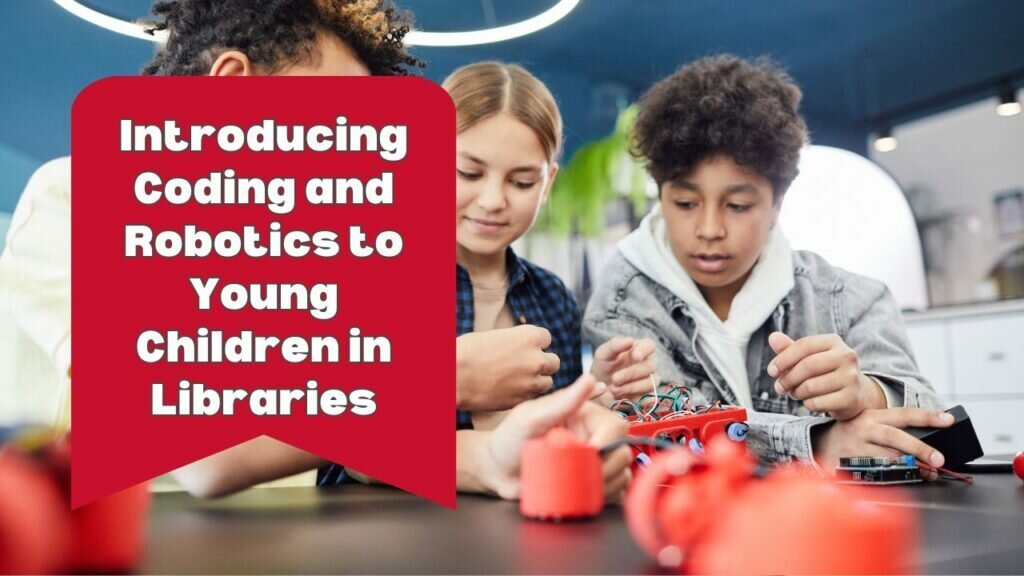
In an era where technology skills are increasingly essential, libraries are evolving beyond bookshelves into innovation hubs. One of the most promising trends is introducing coding and robotics to young children within library settings.
Not only do these programs align with digital literacy goals, but they also nurture computational thinking, problem solving, creativity, and confidence.
Drawing on recent studies and real-world library experiences, this article explores why, how, and what libraries can do to bring coding and robotics to children effectively.
Public libraries are uniquely positioned to host coding and robotics programs because they are accessible, trusted community spaces. Many children may not have access to technology learning opportunities at home or in school; libraries help democratize access.
- Cognitive and metacognitive skills: Coding forces children to plan, test, debug, and reflect. Robotics adds a physical feedback loop, reinforcing computational thinking and metacognitive awareness.
- Improved communication & collaboration: In robotics projects, children often work in pairs or small teams, enhancing communication, negotiation, teamwork. Studies show many parents noted improved communication skills alongside robotics learning.
- Early computational thinking: Research indicates children as young as 5 to 6 (60–72 months) can begin grasping basic programming and robotic kits.
- Increased engagement with STEM: Library robotics programs run during summer showed a statistically significant increase in children’s interest in robotics and related careers.
- Playful learning and language of coding: Some studies describe coding as “playground” or “another language” for young children, blending fun with learning.
- Informal learning environment: Libraries offer non-threatening, choice-driven environments where mistakes are embraced and exploration is rooted in curiosity (rather than grades).
- Reach underserved communities: Libraries often serve children from lower-income backgrounds who might lack exposure to tech programs.
- Flexible scheduling: Coding/robotics clubs or drop-in workshops can supplement school-based offerings or summer learning gaps.
- Community collaboration: Libraries can partner with schools, nonprofits, or STEM organizations to share resources, curriculum, and volunteers.
Below is a summary of typical features and considerations:
| Component | Typical Description / Goal | Notes & Tips |
|---|---|---|
| Target age groups | Usually K–2, grades 3–5, sometimes middle school | Use block-based tools for younger kids; transition to text-based later |
| Frequency & duration | Weekly or biweekly sessions spanning 4–8 weeks | Start small to test interest |
| Hardware & kits | Robots (e.g. LEGO® robotics, Micro:bit, Sphero, Ozobots) | Kits that support both unplugged and plugged modes are ideal |
| Software / interface | Block-based visual programming (Scratch, code.org blocks), custom app interfaces | Visual languages lower entry barrier |
| Facilitation & staffing | Librarians, local educators, trained volunteers | Provide training and support to staff |
| Assessment & reflection | Pre/post surveys, observations, student presentations | Simple metrics: interest, confidence, understanding |
| Community outreach | Open nights, robotics showcases, loanable kits | Encourages uptake and visibility |
In one library case study, starting with a simple “Code Crew” for upper elementary students, librarians expanded to K–2, middle school, and even adult offerings. Over several years, attendance grew from under 900 children to well over 1,200 annually.
- Plan & pilot small
Start with a short series (4–6 weeks) and a manageable group to test interest, staffing, and logistics. - Choose age-appropriate tools
For very young children, select robots that require simple inputs or block programming. Later, introduce more complexity. - Train facilitators
Librarians and volunteers may need instruction in coding logic, robotics hardware, debugging, and helping children when stuck. - Design inclusive curriculum
Scaffold from unplugged (paper/module) logic activities to physical robotics tasks. Encourage exploration rather than rigid scripting. - Foster reflection and iteration
After each session, prompt children: “What worked? What didn’t? How to change next time?” - Measure outcomes
Use simple surveys or observation to track interest, self-efficacy, coding vocabulary, and collaboration. - Promote & sustain
Use social media, library newsletter, community partners to publicize programs. Seek grants or donations for kit replenishment. - Loan & extension programs
Some libraries allow borrowing robotics kits or having home-visit checkouts for continuous engagement.
See also How Small-Town Libraries Bring Big Maker Dreams to Life
| Challenge | Potential Mitigation |
|---|---|
| Cost of robotics kits | Start with affordable platforms (e.g., Micro:bit) or seek grants/sponsorships |
| Staff technical confidence | Offer professional development, peer mentoring, online tutorials |
| Sustainability | Rotate kits, schedule “maker days,” recruit volunteers |
| Accessibility | Provide multiple entry levels; ensure accessibility supports (e.g. wheelchair access) |
| Evaluation difficulty | Use simple methods (before/after interest surveys) and qualitative reflections |
- A 2024 study on summer robotics in libraries found children’s interest in robotics and related careers significantly increased post-program.
- In early childhood coding intervention, children aged 60–72 months showed gains in computational thinking skills when using a robotic coding kit.
- A meta-analysis of robotics education confirms that combining robotics with programming enhances problem-solving ability and executive function in children.
- In some evaluations, parents observed improvements not only in robotics skills but also in communication and persistence in children.
These findings underscore that coding/robotics in libraries is not a gimmick—it produces measurable gains in attitude and skills.
Integrating coding and robotics into library programming for young children is more than a trend—it’s a meaningful investment in future-ready skills, equitable access, and community enrichment.
Through accessible libraries, children who might otherwise lack exposure can experiment, fail, iterate, and grow in computational thinking, collaboration, confidence, and creativity.
By piloting programs, training staff, choosing inclusive tools, and measuring outcomes, libraries can become catalysts for lifelong curiosity in tech and learning.
Furthermore, these initiatives not only prepare children for a digital future but also foster inclusivity, encourage problem-solving mindsets, and build stronger community connections that extend well beyond the library’s walls.
Children as young as 5 to 6 years old can begin with simple robotic kits and block programming. The key is starting with playful, scaffolded experiences.
No — many library systems integrate technology with reading, storytime, and digital literacy. Coding can become part of STEAM (STEM + Arts & Reading) programming.
Use low-cost kits, collaborate with schools or nonprofits, apply for tech grants, or share kits across branches.