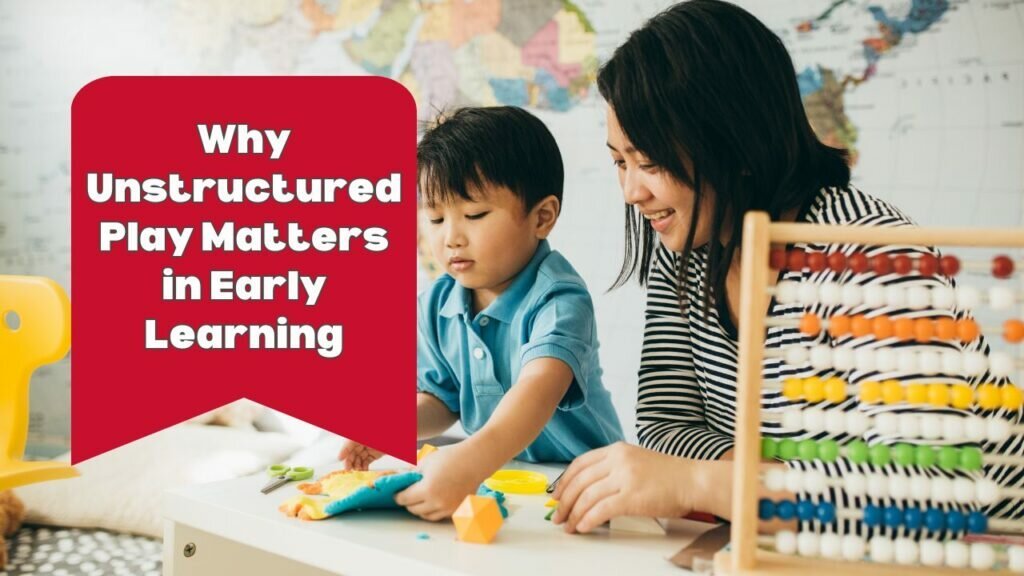
In recent years, researchers, educators, and child development specialists have given renewed attention to the the role of unstructured play (also called free play or child-led play) during early childhood (ages 0–6).
Rather than viewing play as a “break” from learning, current evidence suggests that unstructured play matters deeply in shaping cognitive, social, emotional, and physical development.
In this article we explore why unstructured play matters in early learning, examine supporting facts and figures, and consider how parents and educators can nurture it in practice.
Unstructured play refers to play that is initiated by children, not directed by adults, and without predetermined rules, outcomes, or scaffolding. In such play, children decide what to do, how to do it, and when to change course.
It contrasts with structured play (adult-led games, drills, lessons) or guided play (adult sets constraints or goals but allows child autonomy).
A simple way to differentiate:
| Feature | Unstructured Play | Structured / Adult-Led Play |
|---|---|---|
| Who directs | Child | Adult or instructor |
| Goals/rules | Flexible, self-invented | Predefined, fixed |
| Purpose | Exploration, creativity, self-regulation | Skill practice, curriculum goals |
| Changeability | Dynamic, evolving | Stable, predictable |
| Adult role | Observer, occasional support | Leader, instructor, manager |
During unstructured play, children practice planning, working memory, problem solving, flexibility, and inhibitory control.
A large study found that time spent playing predicts stronger early reading and math skills, with play boosting self-regulation, which in turn supports academic readiness.
Moreover, longitudinal research revealed that children who spent more hours in quiet, unstructured play in toddler and preschool years showed better self-regulation years later.
Play is not just “fun” — it literally wires the brain. A recent study highlighted that unstructured play helps forge neural pathways for cognitive and emotional development, particularly in early years.
The emotional arousal experienced during play helps strengthen consolidation and integration of neural circuits.
Open-ended play materials (blocks, clay, loose parts) allow children to imagine, experiment, break rules, and combine elements in novel ways.
See also Stories That Build – Craft Meets Reading In Early Childhood
Studies show children given open-ended play materials (versus puzzles or worksheets) later produce more creative projects (e.g. collages or dioramas).
In child-led play, children negotiate roles, mediate conflicts, take turns, and learn empathy. They experience managing disappointment, resolving arguments, and reading peers’ emotional cues.
Also, neurochemical studies suggest that play triggers oxytocin (supporting bonding/emotional regulation) and dopamine (helping memory, attention, motivation).
Especially in outdoor and gross-motor unstructured play (running, climbing, balancing), children develop coordination, strength, balance, spatial awareness, and fine motor control.
It also encourages physical activity, counteracting sedentary lifestyles, obesity, and screen overuse.
When children make decisions about their play, they build self-efficacy, confidence in making mistakes, and persistence.
They learn to trust their instincts and to self-regulate rather than being dependent on external direction.
Play provides an emotional outlet, allowing children to express, process, and regulate feelings. In some contexts, play is used therapeutically to help children process trauma or anxiety.
Especially during times of disruption (such as the COVID-19 pandemic), play offers a comforting, safe medium for emotional resilience.
- Studies suggest that free, unstructured play has been declining over recent decades, partly due to increased focus on structured extracurriculars and academic pressure.
- In one survey during COVID lockdowns, parents estimated that children averaged 12.47 hours per week of unstructured play before the pandemic; that rose to 16.32 hours per week during lockdown — a significant increase.
- By fall 2020, the number dropped but still stayed above pre-COVID levels at ~13.77 hours/week.
- Children themselves showed a strong preference: 56.8% preferred unstructured play over structured activities.
- Meanwhile, some schools are reducing recess time or eliminating unstructured play periods under pressure to focus on academics.
These trends are concerning: reduced opportunity for unstructured play may limit critical developmental breakthroughs during early years.
Unstructured play should not be viewed as separate from education but as integral to early learning. Here’s how:
- Integration with Curriculum Goals
Though unstructured, play experiences can dovetail with learning targets (e.g. spatial reasoning, language development). Educators observed that play is among the most powerful ways children consolidate lessons. - Scaffolded Reflection and Dialogue
After play, teachers or caregivers can engage children in reflection: “Why did you build it this way?” or “What would you try next?” These conversations help children make sense of their play and internalize learning. - Observation & Documentation
Educators can unobtrusively observe play sessions, document children’s strategies, and use those insights to inform future design of environments or scaffolded challenges. - Blending with Guided Play
Unstructured play can coexist with guided play, where adults set minimal constraints or prompts but allow children autonomy within them. This hybrid approach can maximize both creativity and learning aim. - Protecting Time & Space
Schools can allocate dedicated daily blocks for unstructured play (even 20 minutes) and design play zones with open-ended materials (blocks, recycled items, natural materials).
See also 5 Hands-On Science Experiments Perfect For Preschoolers
| Metric / Fact | Value / Detail |
|---|---|
| Pre-pandemic average weekly unstructured play | ~ 12.47 hours/week |
| During COVID-19 lockdown | ~ 16.32 hours/week |
| Post-lockdown average | ~ 13.77 hours/week |
| Preference for unstructured play among children surveyed | 56.8% |
| Longitudinal outcome: self-regulation | Children more time in unstructured play in early years → better regulation later |
| Predictive effect on academic readiness | Play time positively correlates with early reading/math via self-regulation path |
| Neural wiring & brain development | Play helps form neural circuits; emotional arousal strengthens consolidation |
Many adults view play as simply fun, not rigorous learning. This misconception leads to pressure to “get to academics,” squeezing playtime out of schedules.
Concerns about injuries or supervision often prompt adults to limit open play or heavily structure environments, reducing children’s autonomy to take age-appropriate risks.
Children today often juggle multiple structured activities (sports, classes, arts), leaving little free time for unstructured play.
Urban settings, small indoor spaces, or lack of outdoor access can limit safe spaces for unstructured, physical play.
Early childhood educators are under pressure to demonstrate measurable outcomes, which can push them toward structured instruction at the expense of play.
- Set aside daily free play blocks (e.g. 30–60 minutes) without agenda or direction.
- Provide open-ended, loose parts materials (blocks, crayons, fabric, recycled items).
- Avoid over-scheduling children; leave unscheduled “white space” in the day.
- Resist giving instructions—offer prompts only when the child asks or seems stuck.
- Observe and narrate: “I notice you stacked blocks high; what else might balance it?”
- Offer safe outdoor spaces or nature walks.
See also How Tinkering Builds Problem-Solving Skills in Preschoolers
- Carve out unstructured play time (recess or free play blocks) every day.
- Equip classrooms or playgrounds with open-ended play materials and natural elements.
- Adopt a play-friendly mindset: teachers act as observers/guides rather than directors.
- Record and reflect on children’s play patterns to inform curriculum and environment design.
- Blend unstructured play with guided play or reflective questioning.
- Advocate for school policies that preserve recess and unstructured play periods.
Unstructured play matters in early learning because it functions as a foundational engine of development across cognitive, social, emotional, and physical domains.
Far from being frivolous, unstructured play is learning: children experiment, self-regulate, imagine, negotiate, and build internal control all while playing.
The evidence — from links to self-regulation, academic readiness, brain connectivity, and well-being — underscores that limiting free, child-led play should be cause for concern.
To harness its power, parents and educators must intentionally protect time and space for unstructured play, resist the impulse to over-structure, and adopt a mindset that honors children’s agency.
In doing so, we allow early learners not just to absorb knowledge, but to become active, curious, resilient, and creative learners from within.
No. Unstructured play is not a substitute for guided learning; rather, it complements structured instruction. The ideal approach is a balance: use directed instruction when necessary but allow ample space for child-driven play, which helps consolidate and deepen learning.
While unstructured play is especially critical in early years (0–6), its benefits extend well beyond. Even older children benefit from opportunities for free, imaginative, autonomous play, though the form may shift with age.
There is no universally fixed “magic number,” but many experts suggest providing at least one hour per day of space for child-led, unstructured play. Some children will naturally engage more, others less, but consistent access is important.